
Coltrane at 100: A Legacy Still Very Much Alive
Five monster players, two young musicians and a living connection to Coltrane
Five Canadian jazz veterans brought John Coltrane's music to Helliwell Hall — after two young Niagara musicians showed why that legacy still matters.
There are tribute concerts that attempt to recreate the music of the person being honoured, and there are concerts that demonstrate why that music still matters.
Wednesday night's John Coltrane 100 at Helliwell Hall was very much the latter.
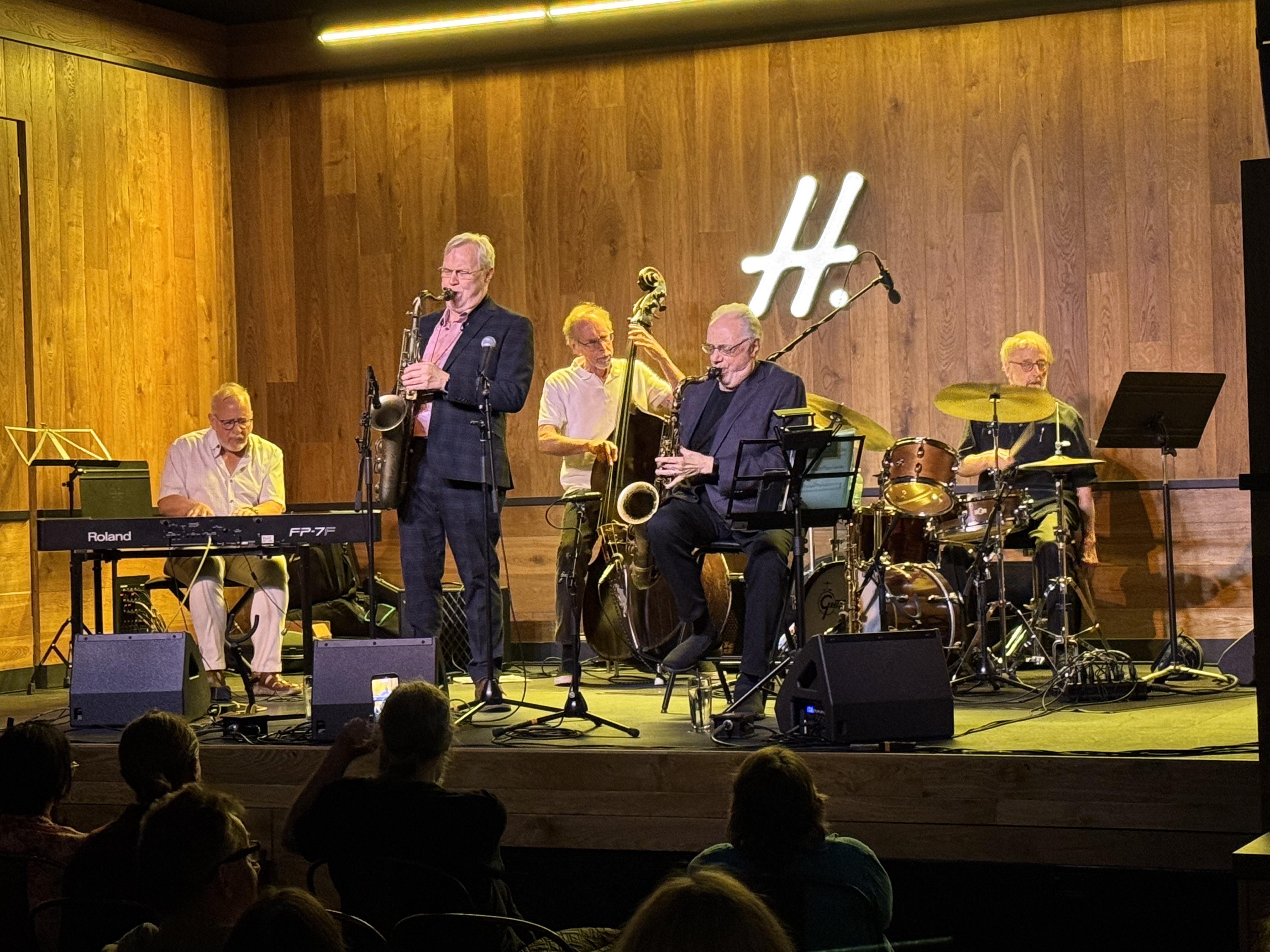
Presented as a fundraiser for the Niagara Jazz Festival, the evening brought together five formidable Canadian jazz musicians — tenor saxophonists Pat LaBarbera and Kirk MacDonald, pianist Brian Dickinson, bassist Neil Swainson and drummer Terry Clarke — to explore the music and legacy of John Coltrane as the centenary of his birth approaches.
Before any of them played a note, however, the evening began at the other end of the jazz timeline.
Two young Niagara musicians supported through the Niagara Jazz Festival's youth initiatives took the stage: saxophonist Claire McNeil and guitarist Julian. They were high-school students playing in front of a room filled with jazz listeners and, shortly afterward, five musicians operating at the highest level of the craft. There were some visible nerves, but they acquitted themselves well, including a take on “All of Me.”
The future of Niagara jazz seems bright seeing the young musicians the Niagara Jazz Festival continues to bring out to these events. NJF doesn't simply talk about supporting emerging musicians; it routinely puts them onstage in front of an audience alongside established professionals. That's a pretty damn good jazz education right there, and I look forward to seeing where these two go from here.
Then it was time for the main event.
The pairing of LaBarbera and MacDonald on tenor was an obvious focal point, but “duelling tenors” doesn't adequately describe what happened between them. Early in the evening I scribbled that MacDonald seemed almost in awe of LaBarbera. Watching more closely, I realized I'd read it wrong. He was listening — intently. Watching LaBarbera work, absorbing what he was doing and seemingly drawing inspiration for whatever MacDonald would say when his own turn came.
And when that turn came: damn, son, you're no slouch yourself.
Their exchanges could be fiery, but some of the most memorable were anything but. “Naima” began with a beautiful, almost remote conversation between the two tenors. At other points they again settled into wonderfully mellow exchanges, weaving in and out of one another so seamlessly that sometimes it was difficult to know where to look.
“Lonnie's Lament,” “Impressions,” “Moment's Notice” and “Bye Bye Blackbird” were among the titles that surfaced during the evening, but this wasn't five musicians treating Coltrane's recordings as sacred texts to be reproduced. They were using his music for exactly what jazz musicians are supposed to use it for: somewhere to begin a conversation.
Calling either tenor the standout would also sell the other three musicians badly short.
The rhythm section alone was worth the price of admission.
Dickinson is difficult to compare neatly with anyone. His chops are extraordinary and his grounding in traditional jazz is obvious, but somewhere along the way he has clearly paid attention to some of the avant-garde cats too. He could support the horns, fill the spaces they left behind and then take the music somewhere decidedly less predictable when given room of his own.
Swainson's upright bass deserves special mention, both for the playing and because we could actually hear the damn thing. Acoustic bass is so often the first instrument to disappear in a live mix. Not at Helliwell Hall. Swainson cut through beautifully without ever sounding artificially prominent.
I've said it before and Wednesday reinforced it: Helliwell Hall may be the best-sounding room in Niagara. Some credit obviously belongs to the soundman Josh, but the room itself has remarkably sympathetic acoustics. Every member of the quintet sounded clear and natural, and hearing Swainson's acoustic bass retain its body and definition throughout the room was particularly impressive.
And then there was Terry Clarke.
Clarke was almost as much fun to watch as he was to listen to. At times he looked as though he were playing with tree trunks rather than drumsticks, and he obviously subscribes to the Philly Lick theory of drumming.
During one solo he even incorporated his music stand into the percussion arsenal, because apparently the drum kit itself wasn't providing quite enough things to hit.
Then LaBarbera casually dropped the revelation of the night.
LaBarbera joked about being old enough to have seen John Coltrane perform many times. But then he pointed toward the drummer sitting behind him.
Terry Clarke had actually played with Coltrane.
According to the story LaBarbera told from the stage, Clarke sat in with Coltrane when drummer Elvin Jones was late. In a concert devoted to Coltrane's legacy, suddenly one of the five musicians in front of us wasn't merely interpreting music handed down through recordings and history. There was a living connection sitting behind the drums.
Judging by the reaction in Helliwell Hall, I wasn't the only one who hadn't known.
That moment probably said more about the evening than any attempt to rank five monster players ever could.
About 125 people filled Helliwell Hall on a misty Wednesday night — not jammed shoulder-to-shoulder, but comfortably busy, and about as full as I'd personally want the room while retaining the intimate character that makes it such a good place to hear this music. The audience listened closely, reacted enthusiastically and understood when the musicians deserved silence as much as applause.
John Coltrane would have turned 100 on September 23.
The musicians onstage Wednesday came from generations that experienced his influence in very different ways. One of them could tell us what it was like to actually sit behind a drum kit and play with him. At the beginning of the evening, two young Niagara musicians were getting some of their earliest opportunities to perform this music publicly.
That's quite a span to fit onto one little stage in downtown St. Catharines.
And perhaps that's the point.
Coltrane's legacy isn't something sitting behind glass waiting for a centennial celebration. It's still being listened to, interpreted, challenged and passed along.
Wednesday night, we got to watch that happen.