
Chest Fever's The Last Waltz: Some Performances Defy Polite Language
A remarkable recreation, a parade of Niagara talent and a few moments that demanded stronger vocabulary
In 1978, my father took me to see The Last Waltz at the old Town Cinemas in downtown St. Catharines, just a few doors down from where the FirstOntario Performing Arts Centre now stands.
I was nine years old.
I'd dressed for the occasion in my best rock 'n' roll T-shirt, complete with a little pin with wings that somebody had assured me would make me look badass.
I was going to see rock 'n' roll royalty.
And in a way, I was. For a nine-year-old who hadn't yet experienced a real rock concert, Martin Scorsese's film of The Band's farewell performance was about as close as I could get.
Nearly fifty years later, I found myself back on practically the same stretch of St. Catharines pavement, this time inside Partridge Hall, watching Chest Fever recreate that very concert.
Our lovely musical tour guide for the evening, Katie, introduced Chest Fever, and the band wasted absolutely no time.
No slow burn. No easing us into the evening. They came out of the gate at full throttle, rocking like they'd been playing all night.
BAM!
Looking back at the notes I scribbled during the performance, the very first two words I wrote were:
Holy shit.
And I stand by them.
What struck me almost immediately was just how convincingly Chest Fever recreated the sound and feel of The Band.
The guitarist's voice sounded remarkably like Levon Helm. Close your eyes and, at times, it was almost uncanny. The instruments and voices didn't necessarily line up with their counterparts in the original group, but somehow the whole thing worked.
The drummer was fantastic. What amused me was how calm he looked, even when he was absolutely thrashing behind the kit during extended instrumental passages. His expression barely changed while his arms were doing considerably more strenuous work. He was a pretty good singer, too, handling some of Rick Danko's vocal parts, although those duties were shared with the piano player.
The bass player, one of only two members who didn't sing, was another pleasure to watch. Smiling, bobbing, weaving and occasionally doing little dances while holding down the bottom end, he looked like a guy having the time of his life.
Then there was the mysterious man behind the Hammond organ.
I say mysterious because, for much of the evening, I couldn't actually see him. He was almost completely hidden behind that enormous instrument. Occasionally a hand would emerge to play another keyboard, or his head would pop into view when he really started rocking. Every so often he'd stand up, briefly confirming that there was indeed a whole musician back there.
And what a musician.
The piano player was no slouch either. He handled some of Rick Danko's vocals as well as Richard Manuel's, and could get funky, slip into some wonderfully gospel-flavoured playing and bring a whole lot of soul to the arrangements.
During “Georgia on My Mind,” he helped take the music somewhere close to church.
By the time that song reached its peak, we were practically holding a revival meeting in Partridge Hall.
Of course, one of the things that made the original Last Waltz so memorable was the extraordinary collection of guest musicians joining The Band onstage.
Chest Fever brought that same idea to Partridge Hall, with an impressive lineup of Niagara-area musicians stepping into the roles of some legendary performers.
Mark Lalama was among the first to grab my attention, taking on the Dr. John role.
I've always loved Dr. John's appearance in the original film. Every time I watch it, I find myself thinking the same thing when his performance ends:
Aww, does he have to stop already?
Thursday night, Lalama gave me exactly the same feeling.
He brought that wonderful New Orleans piano feel to the performance, and I could happily have listened to considerably more of him.
Pat Vandersluys stepped into Paul Butterfield's shoes, bringing excellent blues harp and vocals to the stage. What impressed me was his restraint. Butterfield could be a ferocious harmonica player, and Vandersluys certainly had the chops to let loose, but he didn't feel the need to blow the roof off every time he raised the instrument to his mouth.
He played what the music needed.
And sometimes that's more impressive than showing everybody how many notes you can play.
Then came Nicole Cerminara.
Taking on the Eric Clapton role for “Further On Up the Road,” Nicole was absolutely on fire.
I've seen her perform with JIN and tackle some demanding material before, so I already knew she could play.
Apparently I still hadn't seen everything.
Great tone, plenty of chops, and the kind of musical instinct that separates a good guitarist from a genuinely exciting one.
And she wasn't finished.
Leroy Emmanuel joined the festivities in the Muddy Waters role for “Mannish Boy,” with Nicole remaining onstage.
I've been watching Leroy perform for some forty years, and I even took a few guitar lessons from him back in the 1980s. Not nearly enough lessons, mind you, but that's hardly his fault.
Thursday night, he reminded everyone why he's been such an important part of Niagara's music scene.
He owned “Mannish Boy.”
Leroy improvised freely, bringing his unmistakable personality to the performance, and was generous with his praise for Nicole. He referred to her as his “soul princess,” and the affection and respect between the two musicians were obvious.
There was something wonderful about watching these two generations of Niagara guitarists sharing the stage, each clearly appreciating what the other brought to the music.
When the song ended, Leroy and Nicole left the stage together.
Or at least, that appeared to be the plan.
Nicole was called back.
At first, I thought the band had simply been so impressed with her playing that they wanted to keep her around longer.
The next number didn't appear to be one she knew particularly well. She hung back, found her way into the key and added a little guitar here and there.
Then came the solos.
Suddenly, Nicole and Chest Fever's guitarist were engaged in a full-blown guitar cutting contest.
Back and forth they went, trading blistering passages and pushing each other further.
They absolutely WAILED.
I've been trying to find a suitably eloquent way to describe just how impressed I was.
But I think I'll stick with what I actually felt.
Nicole Cerminara fucking killed.
During intermission, a woman I'd met before the show approached me with a question.
“Who was that Black man?”
For a moment, I did a double take.
Then I remembered.
Oh, right. You're new to the area.
I explained a little about Leroy Emmanuel, his decades on the Niagara music scene and how his band, LMT Connection, has become something of a local legend.
It was a funny reminder that musicians we sometimes take for granted around here aren't necessarily household names to someone who's just arrived.
But they certainly should be.
Nicole returned during the second half for “Atlantic City,” delivering a guitar solo that sounded less like something improvised onstage and more like a polished studio take.
Every phrase seemed to belong exactly where she'd put it.
As if we needed another reminder of what she could do.
One of the pleasures of the evening was seeing how differently the guests approached their assignments.
Riss Nixon, taking on the Neil Diamond role, was a particularly entertaining surprise. Her rendition had an almost punky, 1980s glam-rock quality, which certainly wasn't what I expected from a Neil Diamond number.
A little strange, a little theatrical, and a whole lot of fun.
Then there was Amanda Lyn Parker, stepping into Emmylou Harris's shoes.
Now, anyone who knows me knows I'm not exactly the world's biggest country music fan.
But I know a good singer when I hear one.
Amanda, who normally works as a monitor technician at the FirstOntario Performing Arts Centre, found herself on the other side of the monitors Thursday night, centre stage in Partridge Hall.
And could she ever sing.
Her voice was beautiful and expressive. I might not have been the most enthusiastic country music listener in the room, but she had my full attention.
Serena Pryne, meanwhile, was an absolute ball of fire in the Van Morrison role.
She brought a wonderfully husky, soulful voice, a playful stage presence and enough personality to fill Partridge Hall. She seemed to be having an absolute blast, and the musicians around her looked as though they were enjoying her performance every bit as much as the audience.
You couldn't help but smile watching her.
Zach Bury's interpretation of Neil Young on “Helpless” was something else entirely.
His vocal delivery and animated mannerisms were certainly unconventional. Someone suggested it was almost like watching a Saturday Night Live sketch, and I could understand the comparison.
But I didn't see it as a parody. Bury seemed to be giving us his own eccentric interpretation of Neil Young, and he certainly committed to it.
Sean McClelland contributed Joni Mitchell's part, including those haunting backing vocals during “Helpless,” just as Joni had sung from offstage in the original concert. Her appearance felt a little rushed, and I would have liked to hear more.
And let's not forget the fiddle.
Lauren Leprich brought wonderful energy to “Rag Mama Rag,” adding another colour to an already lively arrangement. The piano playing got delightfully funky, too. My friend Darrell described it as “Peanuts jazz,” and I knew exactly what he meant.
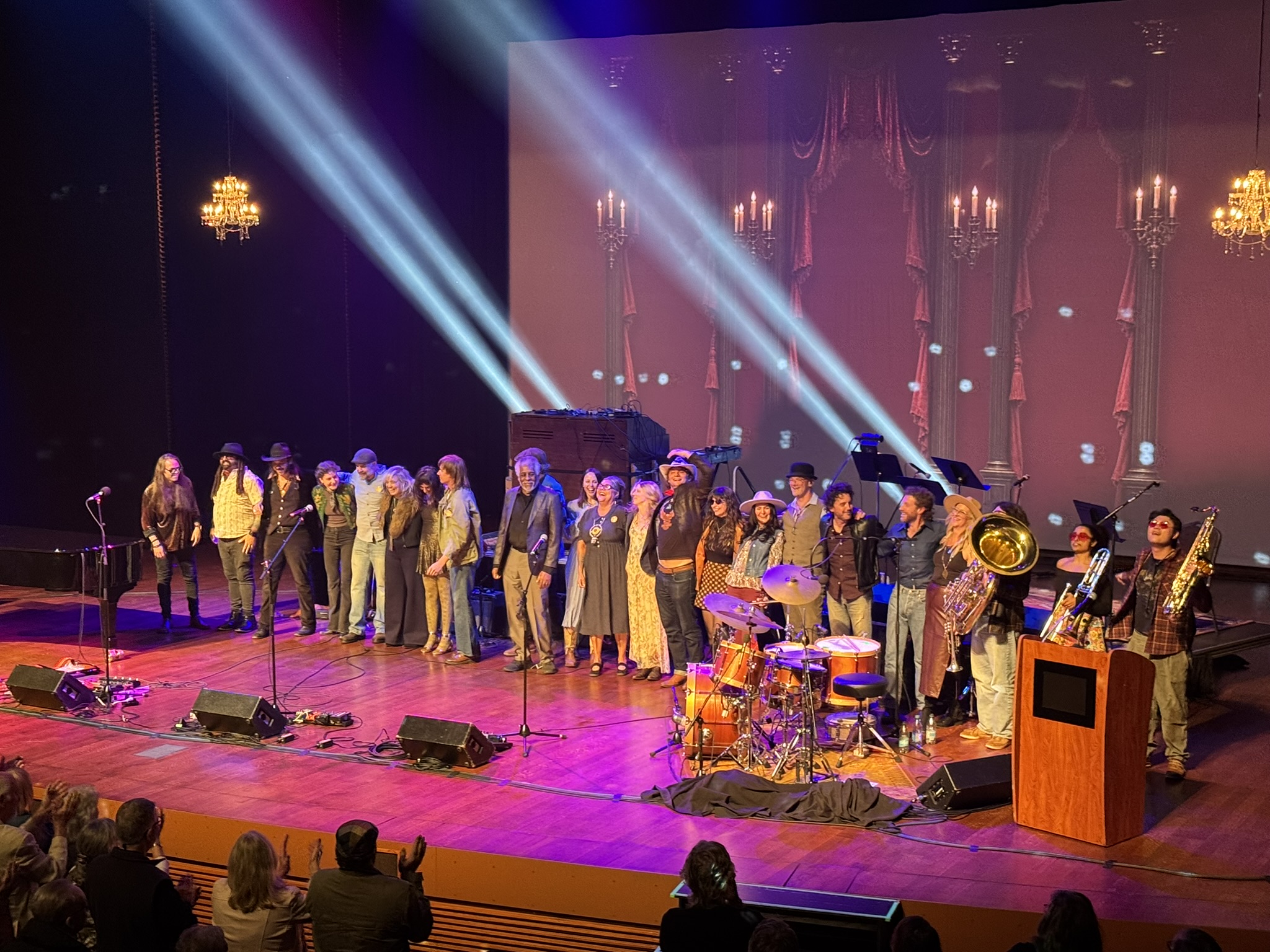
The horn section came courtesy of Niagara's own My Son the Hurricane, with Liam Bird on saxophone, Daniel Monstaseri on tuba, Alyssa Shanghavi on trombone and Lisa Gudgeon on trumpet.
They brought some serious brass power to the arrangements, and even a minor microphone issue couldn't completely silence Gudgeon's trumpet. We could still hear her playing acoustically.
Incidentally, My Son the Hurricane will be performing right here at the FirstOntario Performing Arts Centre next Saturday, October 17. If Thursday's performance left you wanting more of Niagara's homegrown musical talent, there's your next opportunity.
Gravely James appeared in the Ronnie Hawkins role, while January Rogers contributed to the Robbie Robertson tribute, adding still more local talent to an already impressive lineup.
And then there was Bob Dylan.
Billy Rogers took on that assignment, but not before the mysterious Hammond organist provided one of the evening's funniest surprises: a hint of the Hockey Night in Canada theme during a solo.
I laughed out loud.
Somewhere amid all this musical celebration, Chest Fever also delivered a performance of “The Night They Drove Old Dixie Down” that very nearly brought me to tears.
I was singing along at the top of my lungs.
There's something about that song, particularly when it's performed with conviction, that reaches straight into memories you've carried around for decades.
For a moment, I wasn't thinking about who was playing which part or how closely they were recreating the original arrangements.
I was completely lost in the music.
And really, isn't that what a concert is supposed to do?
As the evening drew to a close and the performers gathered together onstage, I found myself thinking back to that nine-year-old kid sitting in the Town Cinemas in 1978.
The one with the rock 'n' roll T-shirt and the little winged pin, convinced he was about to witness something extraordinary.
Nearly fifty years later, just a few doors down the street, I got to experience a little of that magic all over again.
Chest Fever and their Niagara guests didn't simply recreate a famous concert. They reminded us why that music has stayed with so many of us for so long.
And they demonstrated just how much remarkable musical talent we have right here in our own backyard.
I think that nine-year-old kid would have been pretty impressed.
As for the considerably older version?
Holy shit, what a night.