
An almost perfect evening at Chateau des Charmes
For a tennis fan, doubles with Ashe; for a golfer, a foursome that includes Rory; for a Habs fan, lunch with Maurice Richard; and for a baseball nut, batting practice with “the Babe.”
BUT, for an opera buff, an evening of arias sung by a superior diva and tenor divo is Oscar® night. I certainly ARE (sic) an opera devotee.
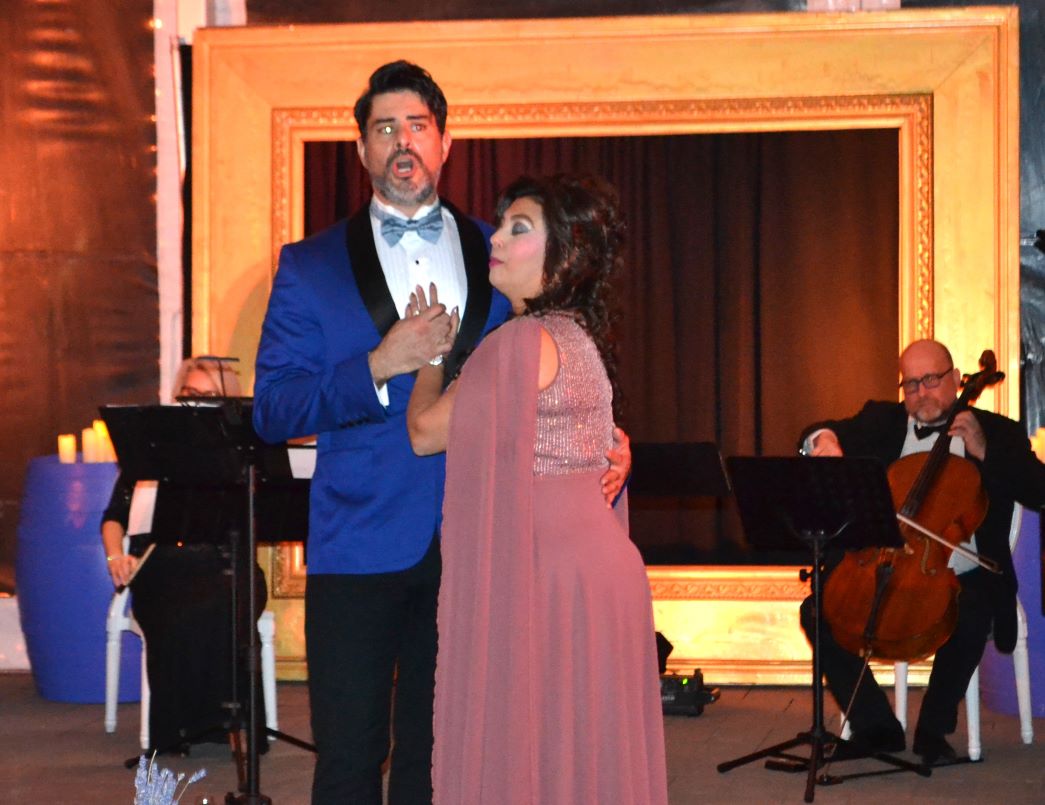
Last night, in the enclosed tent at Château des Charmes, tenor Giacomo Folinazzo and soprano Maria Vetere wowed my socks off, along with those of some seventy-five other guests. From their opening duet, the Brindisi, or “Libiamo” — Italian for “Let's drink” — their portrayals of Violetta and her new beau Alfredo made me envision Verdi's young lovers on their first date.
Vetere is a local artist of Italian heritage who has performed worldwide. She is also a noted conductor. Her soprano voice is mellow, clear and tonally faultless right across her range. Her facial expressions mirror both the message and the lyrics. There is a definite sincerity in her introductory monologues that is endearing.
Her range and delivery are evocative of New Zealand's Kiri Te Kanawa, whose lyric soprano was ubiquitous back in the '70s. This coming February, Vetere will be singing Cio-Cio-San in Madama Butterfly and will undoubtedly excel at expressing the heroine's faith that one fine day, Pinkerton will return for her and their child — “Un bel dì, vedremo.” That role also has the tear-jerking hara-kiri ending that challenges every soprano. (Sorry for the spoiler.)
Folinazzo is also a local talent. Surprisingly, he began his interest in opera at age thirty. The man is exceptionally tall, with a matinée-idol visage and a powerful tenor voice. To call him animated is an understatement.
He, too, has performed far afield, is the producer of the Château's presentations, and is deeply involved with an undertaking I'll be discussing at the end of this column. (STAAAAY WITH US.)
When designing the evening's programme, he thought some diversification from the operatic genre would make for broader audience appeal. His solo, “Torna a Surriento,” was mesmerizing and evocative of Terry's and my trip down the Amalfi Coast eight years ago.
It was already somewhat chilly when the duo introduced the audience to their interpretation of Rodolfo and Mimì's famous duet. My mind went to “Che gelida manina” — What a cold little hand — as my own fingers were beginning to numb. Given my awareness of the libretto and its ending, I began to cry.
An intermission break allowed me to apologize to the quartet seated next to me. Turns out they were from Rochester and were repeat visitors. Sharing my affection for this type of programme, they professed that such behaviour is de rigueur for true opera buffs.
Vetere gave us an aria from a Ravel opera that I thought was called “Una Mata.” I'm sure old Maurice composed only two operas, L'heure espagnole and L'enfant et les sortilèges, and I must admit to never having heard either. But her a cappella rendering was vocally a treat.
Then Folinazzo sang Elvis's “Can't Help Falling in Love” in Italian. FYI, the melody actually has its origins in a French song. A resonant “La Paloma” by Vetere was followed by the famous Godfather theme, sung in Italian and given a rich tenor rendering.
Post-intermission came costume changes, including glitz and glamour for Vetere, and an outfit for Folinazzo à la Neil Diamond's iconic Jazz Singer jacket. Certainly suitable for his “'O sole mio.”
Another mea culpa: I couldn't help singing “There's No Tomorrow” to myself.
Then came the finale and a suitable encore — the ubiquitous Bocelli/Brightman duet, “Time to Say Goodbye.” The time was 10:30 p.m., and thus it was!
The soloists had a backing quartet of musicians: harpist Siobhan Kerr, Gordon Cleland on cello, pianist Erika Relman, and violinist Cynthia Konopka. Konopka was given the opportunity for a solo and demonstrated a symphony-orchestra level of virtuosity. Their contribution to the overall effectiveness of the evening was incalculable.
Château des Charmes is, like its name, charming! Both the building and its wines are French in style. The winery is among the region's longstanding establishments, dating from 1978. Its Aligoté has won awards, and the architecture of the mansion is itself impressive.
Administrators Andrew and Sarah take hospitality to heart and keep pushing the bar (pun intended) even higher.
One unique offering is a “proposal package,” whereby a prospective groom arranges a weekend, completely in secret and with coded messages, to set the perfect atmosphere for popping the question.
Wish I'd had such a chance. Terry and I got engaged with the 1962 Grey Cup — the famous Fog Bowl — in the background.
The operation supports local talent and offers opportunities for the up-and-coming to strut their stuff. Its evening-event clientele appreciate the Château's high standards, so dress and demeanour reflect the same.
Glad I wore a tie.
The only negatives? The acoustics, especially for monologues, are challenging, and the tent gets chilly, given that it's autumn. So I give the evening a 9.5, and hope that's high enough for a re-invitation.
Now, back to paragraph three.
Opera isn't for everyone. I've given up trying to convince philistine naysayers that it's more than yelling foreign phrases, unhappy endings, boring stories, sleep-inducing recitatives (definition: the yatter between arias), and repetitive surtitles or subtitles.
It IS an art form and deserves more than derision.
I don't denigrate those who enjoy tossing a ball into a hanging pail, putting a little ball into a cup, kicking an inflated sphere, or chasing a leather oval around while slamming into others. If that's your idea of the cat's pajamas, enjoy it!
Enjoy what you like and what you think is important.
I'm for the arts.
Giacomo Folinazzo is head of an organization Danny identifies as Firenze Prod, whose goal is the promotion of opera in this region.
There are many vocalists whose opportunities are severely limited, not only financially but also in terms of public exposure. Staging an opera is a major undertaking and is only possible by getting sufficient bums in seats to cover the financial nut.
If more locals would step up to the plate (a sports allusion) and both promise and demonstrate their support by attending such undertakings, perhaps artistic and cultural philanthropic agencies would be encouraged to do so as well.
I'm at an age when I'm playing the back nine (another sports allusion), so a positive expansion may not affect me much. BUT there are kids out there who might discover a lifelong cultural appreciation and benefit.
I started enjoying radio's Saturday afternoons at the Metropolitan Opera when I was nine! My wife started ballet while still in single digits. Neighbourhood kids started music lessons while also attending grade school.
We benefited from that exposure. Today's youngsters have countless distractions competing for their attention, and I wonder whether enough of them are getting the same opportunities to discover the arts.
Something's missing here.
Let's try to fix it.